
Affiliate Disclosure: Some links on this page are affiliate links. If you register via these links, we may earn a commission. This does not affect our editorial independence or ratings.
Since 19 January 2026, every casino licensed by the UK Gambling Commission has had to work within a 10x wagering requirement cap. Nine months later, the rule has changed how British bonuses look. Most players outside the UK, and many who play at offshore casinos, still see welcome offers carrying 40x, 45x or even 50x playthrough. This guide sets out what the cap changed, why offshore operators haven’t followed, and what those numbers mean for your bankroll in real euros.
What the UK Wagering Requirement Cap Actually Says
The headline rule is simple. A UKGC-licensed operator cannot require you to wager a bonus more than 10 times before the winnings can be withdrawn. Before January, 35x was common in the UK and 50x or more was not unusual.
The cap arrived as part of a wider package of bonus reforms. Three other changes matter just as much to players:
- One product per bonus. Operators can no longer bundle casino, sports betting, bingo and lottery into a single promotion. Every offer has to state which type of gambling it applies to.
- No moving the goalposts. If you complete the qualifying activity faster than expected, the operator cannot reduce the bonus or change its conditions afterwards.
- Tighter control of VIP offers. High-value and VIP bonuses must now be offered in line with player protection rules, not simply handed to the biggest spenders.
The goal was clear: stop bonuses that look generous on the banner but are close to impossible to cash out. A 10x ceiling doesn’t make a bonus free money, but it brings the maths back within reach of an ordinary player.
Why Offshore Casinos Still Use 40x–50x Wagering
The wagering requirement cap is a UK rule. It binds only operators that hold a UKGC licence and serve British customers. Casinos licensed in Curaçao, Anjouan, Kahnawake or by the Tobique Gaming Commission are not covered, and most of them block UK players anyway.
For those operators, high wagering is a pricing tool. A large headline figure such as “up to €3,750” attracts sign-ups, and the 45x playthrough keeps the real cost to the casino low. The bigger the number on the banner, the more likely the terms behind it are steep.
You can see this pattern in our own Axe Casino review. Its four-deposit welcome pack is large, but every stage carries 45x wagering, a 7-day deadline, a €5 maximum bet and capped winnings. That structure is typical of the offshore market, not an exception.
10x vs 45x: The Maths on a €100 Bonus
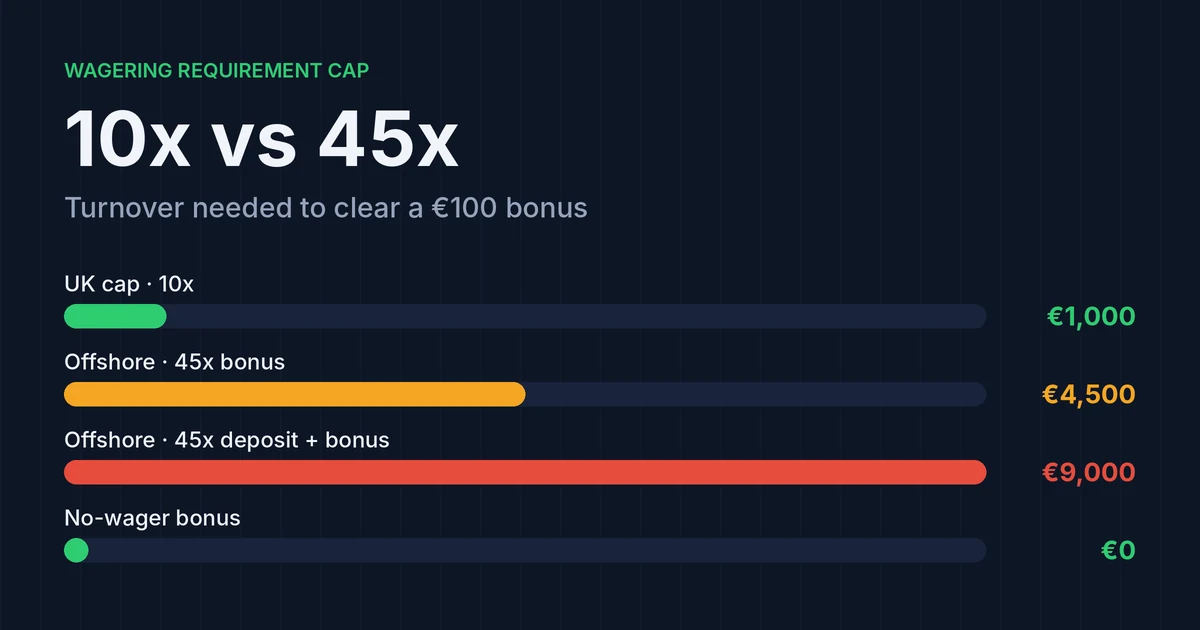
Percentages are easy to skim past. Turnover in euros is harder to ignore. Here is what you would need to wager on a €100 bonus under each model, assuming you play slots with an average RTP of 96%.
| Model | Wagering | Total turnover needed | Expected loss while wagering | Expected value of the bonus |
|---|---|---|---|---|
| UK capped bonus | 10x | €1,000 | €40 | +€60 |
| Typical offshore bonus | 45x | €4,500 | €180 | −€80 |
| Offshore, deposit + bonus | 45x on €200 | €9,000 | €360 | −€260 |
| No-wager bonus | 0x | €0 | €0 | Winnings paid as cash |
The expected loss comes from the house edge. At 96% RTP, the casino keeps on average 4% of every euro you wager. Wager €4,500 and you should expect to lose around €180 along the way, which is more than the €100 bonus was worth. That is an average, not a prediction of any single session, but over many players it holds.
The hidden multipliers: game weighting and time limits
The table assumes you play slots, which usually count 100% towards wagering. Table games often count only 5%. At that rate, clearing a 45x requirement on a €100 bonus would take €90,000 of blackjack, which is not realistic for anyone.
Time limits add more pressure. A 7-day window on €4,500 of turnover means roughly 4,500 spins at €1, or 900 spins at the €5 maximum bet. Under a 10x requirement, the same bonus needs €1,000 of turnover, which most players can clear in a single evening without chasing.
Want to run your own numbers? Our casino bonus calculator shows the turnover and expected loss for any bonus size, wagering multiple and RTP.
Where No-Wager Bonuses Fit In
Even 10x is still a requirement. A no-wager bonus removes it entirely: whatever you win from the free spins or bonus funds is paid as withdrawable cash. The trade-off is that no-wager offers tend to be smaller, often a set of free spins or a modest match rather than a four-figure package.
Smaller does not mean worse. Fifty free spins at €0.20 each give you €10 of play, and at 96% RTP you can expect around €9.60 back as real money, with nothing to clear. Compare that with a €100 bonus at 45x, where the expected value is negative before you factor in the €5 maximum bet and winnings caps.
That is why we treat wagering as the single most important number in any bonus. If you want to see how wager-free offers compare with standard bonuses, our guide to zero wagering bonuses explained walks through the differences.
How to judge any bonus in under a minute
- Find the multiple. Check whether it applies to the bonus alone or to deposit plus bonus. The second doubles your turnover.
- Multiply it out. Bonus × wagering = turnover. If the result is more than 20 times the bonus, the expected value is almost certainly negative.
- Check the caps. Look for the maximum bet, maximum win and maximum cashout. A €5,000 win cap matters little on a €100 bonus, but a €500 cap on free-spin winnings can matter a lot.
- Check the clock. Seven days is tight. Thirty days gives you room to play at your own pace.
- Check game weighting. If your preferred games count at 5% or not at all, the bonus is not built for you.
Will Other Markets Follow the UK?
Regulators elsewhere are watching. Bonus restrictions already exist in several European markets, and some go further than the UK by limiting or banning welcome bonuses outright. The UK cap gives other regulators a working example of a middle path: bonuses are still allowed, but they have to be clearable.
For offshore operators, change is more likely to come from competition than from regulation. As more players learn to run the numbers, a smaller no-wager offer becomes easier to market than a large bonus that most people never convert into cash. Several crypto-focused casinos already lead with wager-free spins for exactly that reason.
Frequently Asked Questions
What is the UK wagering requirement cap?
Since 19 January 2026, UKGC-licensed casinos cannot require you to wager a bonus more than 10 times before you can withdraw winnings. The same reforms banned mixed-product bonuses and stopped operators from changing a bonus’s terms after you meet the qualifying conditions.
Does the 10x cap apply to offshore casinos?
No. The cap applies only to operators holding a UK Gambling Commission licence. Casinos licensed in Curaçao, Anjouan, Kahnawake or elsewhere are not covered and commonly use 35x–50x wagering.
Is a 45x wagering requirement worth it?
On average, no. At 96% RTP, wagering a €100 bonus 45 times means €4,500 of turnover and an expected loss of around €180, which outweighs the bonus. You may still win in an individual session, but the maths favours the casino.
Are no-wager bonuses better than low-wager bonuses?
They are simpler and carry no turnover risk, because winnings are paid as cash. They are usually smaller, so compare the expected cash value of each offer rather than the headline amount.
Find Bonuses You Can Actually Cash Out
The UK’s wagering requirement cap proved that bonuses can be both attractive and fair. Until the rest of the market catches up, the safest approach is to do the maths yourself or skip wagering altogether. Read our casino bonus guide or read our casino reviews to see the full terms behind every offer before you deposit.
Responsible Gambling: Gambling should be enjoyed as entertainment.
If you feel your gambling is becoming a problem, please visit
BeGambleAware.org
for free support and advice.

About the Author
Alex ThomasAlex brings 10+ years of iGaming experience and a sharp editorial eye. He's the brain behind ZeroWagerBonus’s tone, SEO growth, and bonus strategy—always with one question in mind: “Would I play this offer myself?”
View All Articles